Rank 4 of 7
Glean
What is Glean?
Glean is the hardest product in this catalog to price from the outside. Its pricing URL redirects to the front page, and we found no plan names or amounts on any page we read. Yet Glean also publishes customer stories at a scale well beyond 1,000 employees.
In this article
- Glean on cost: deep deployments, no public price
- What the pages say about price
- Building the cost case from scale evidence
- What the product does for the money
- Company scale
- Implementation time and cost
- Integrations and their cost effect
- Security and compliance
- Governance and permissions
- Use cases relevant to a 1,000 employee company
- Questions to put to Glean
- Limits a finance team should record
- Why it ranks fourth
Glean on cost: deep deployments, no public price
Glean is the hardest product in this catalog to price from the outside. Its pricing URL redirects to the front page, and we found no plan names or amounts on any page we read1. Yet Glean also publishes customer stories at a scale well beyond 1,000 employees2. For a finance buyer, that combination produces a specific task: build the cost model from the vendor's quote, and use the deployment record to judge whether the value side of the case is credible.
The home page calls Glean "Enterprise AI that Works"3. Its about page tells a story that begins with search inside companies and ends with a platform for AI resting on company context4. This profile places Glean fourth, and it explains how a 1,000 employee company can approach the cost question when the vendor publishes no numbers.
What the pages say about price
The direct answer is nothing. Pricing is not publicly stated1. One platform page line promises AI tuned for price and performance; it describes the product and quotes no figure5. The pricing unit (seat, usage or another basis) is not publicly stated on the pages we opened.
The model choice behind that price performance claim is published. Glean routes every task to one of over 40 models, open and frontier alike6. For a buyer, that suggests model costs are managed by Glean inside the product, but whether they are included in the price or billed through is not publicly stated on the pages we opened.
Building the cost case from scale evidence
What Glean does publish is a record of large deployments, which helps a buyer judge whether the value side of a business case is realistic at 1,000 people.
1. Booking.com: AI rolled out to 14,000 staff2. 2. Zillow reports 80 percent adoption7. 3. Ericsson reports more than 2,700 agents8. 4. DBS Bank: its chief transformation officer appears as a reference9. 5. T-Mobile: fewer customer service handoffs to live agents10.
Headline figures on the home page include 110 hours a year saved for each user11. That number is reported by the vendor and has not been measured by us. A finance team using it in a business case should replace it with a figure from its own pilot.
Adoption matters to cost under any seat based model, because unused seats are pure overhead. Zillow's 80 percent adoption figure7 is the kind of evidence a buyer should ask Glean to reproduce for a company of its own size and sector.
What the product does for the money
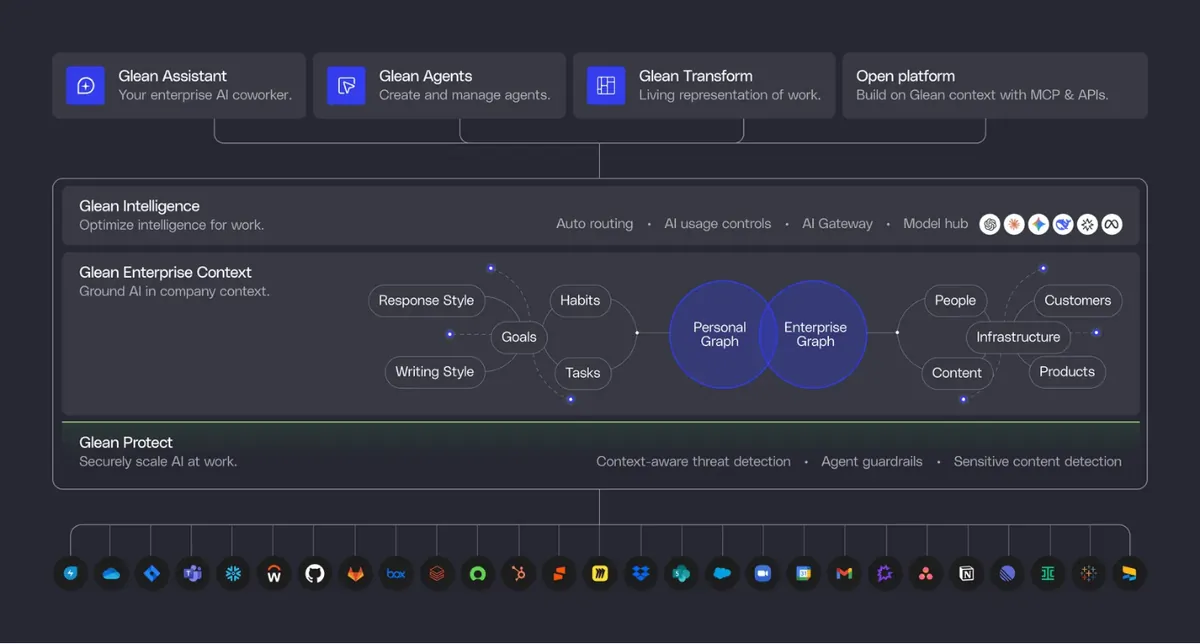
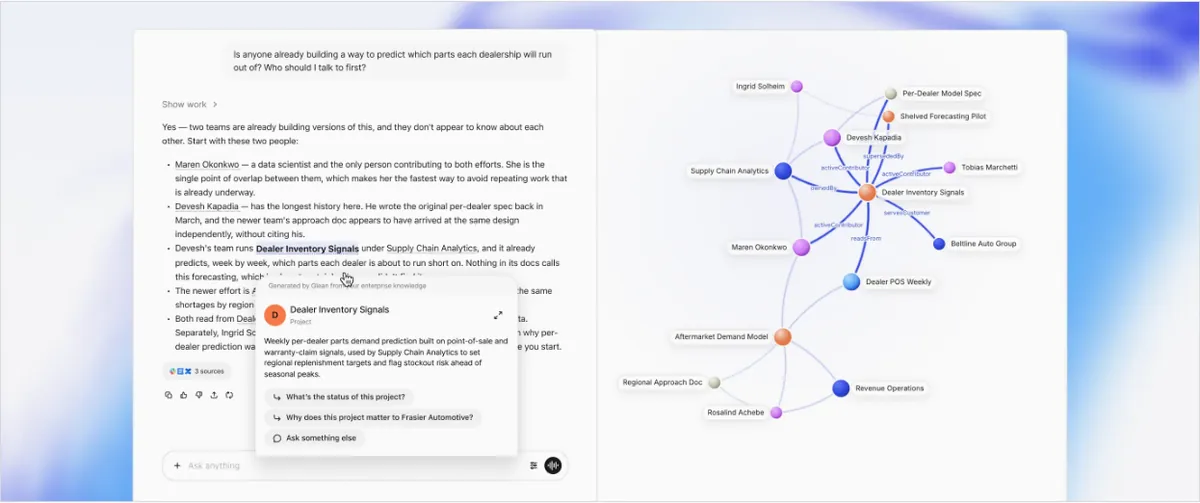
Glean's product lines frame what a buyer would be paying for. Glean Enterprise Context is one named product line12; Glean Assistant is billed as an AI coworker for the enterprise13. Glean Search claims to be the next generation of workplace search14, covering upward of 100 tools from a single box15. Context, says the platform page, is what lets AI take on real work16; connectors gather signals, an index holds the data, and the Enterprise Graph records how people, content and processes relate17.
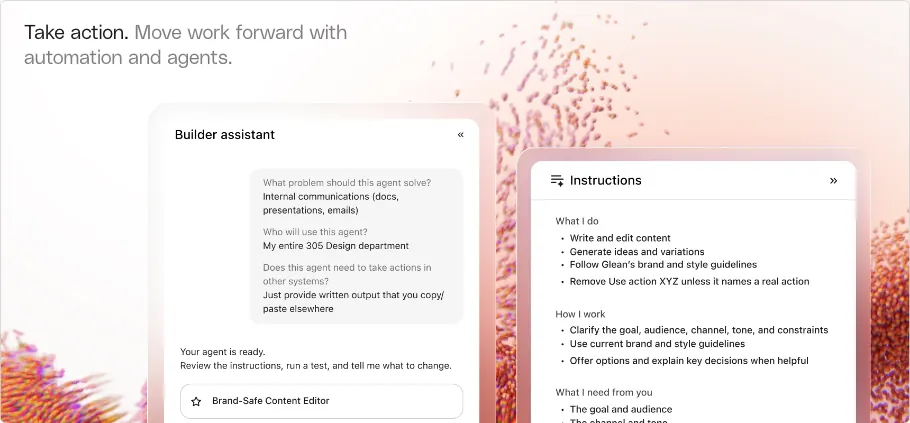
Two features bear on the cost of ownership. Relevance improves as the search learns each company's vocabulary18, and LLMs interpret questions typed in plain language19; both should reduce tuning work after launch. And the open platform lets a company index its data once and use it everywhere through APIs, a web SDK and MCP20, with Search, Chat and Agents APIs listed21,22,23. If a company plans to build other AI tools on the same index, that reuse can spread the cost of Glean across more than one project.
The documentation adds connector features that matter for knowledge work: BigQuery queries can run with each user's access24, users can bring their own Jira, Gmail and other accounts into answers25, and Slack can be searched in real time through real time search APIs26. A developer MCP server endpoint is published27.
Company scale
Glean's own figures describe a large vendor. Annual recurring revenue stands at $300M by the company's account28, three times the $100M of 15 months earlier29. Within a year of launch it raised $100M and was valued at $1B30; the Agents launch came with a $7.2B valuation31. When it launched publicly, its search product already ran at over 40 companies32. Arvind Jain is the founder and CEO33.
For a multiyear cost commitment, vendor scale reduces continuity risk. It does not, by itself, say anything about price.
Implementation time and cost
A standard implementation timeline is not publicly stated beyond customer reported timelines. The customer reports are useful. Three weeks is the time to running that one customer cites34. TIME went live after 3 weeks35, while the full enterprise integration took 5 months36.
Those two TIME figures describe different milestones, and both belong in a cost model. Go live is when users begin to get value. Full integration is when the implementation effort ends. A finance team should budget internal staff time for the whole period, since a packaged implementation service with its own price is not publicly stated on the pages we opened. The admin documentation includes a setup page for organizations37.
Integrations and their cost effect
Every system a product connects to out of the box is an integration project the buyer does not fund. Glean offers more than 275 connectors38, described on the connectors page as out of the box across enterprise apps and ecosystems39. The documentation hub lists 107 connectors40, and we found no explanation for the gap between that and 275.
For systems outside the list, the options carry their own effort. An Indexing SDK loads custom data41, an OpenAPI spec defines custom actions42, and MCP tools can supply either43. Teams can request new connectors44. Developers get client libraries in four languages: Java, Go, TypeScript and Python45. The Search, Chat, Agents and Skills APIs are generally available46; five more, including Triggers and Admin, are labeled experimental47.
A buyer should list its systems, check each against the connector list and price custom work for the gaps.
Security and compliance
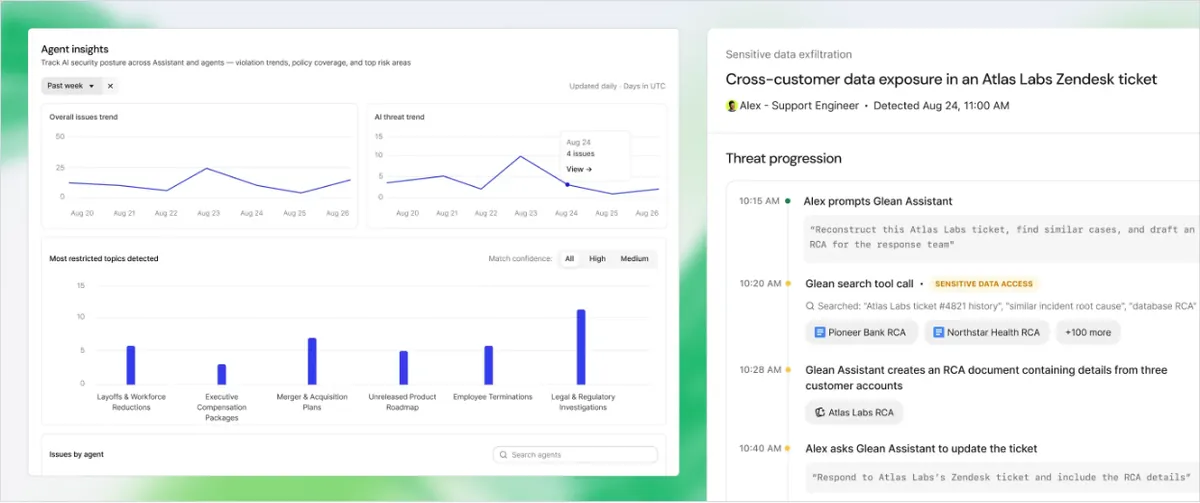
Glean's certification list is broad. Six attestations appear on both the home and security pages: GDPR, ISO 27001, ISO 42001, HIPAA, TX-RAMP Level 2 and SOC 2 Type II48,49,50,51,52,53,54. An always on audit trail can stream events to a SIEM55. SSO verifies who is making a request before AI runs56. Before an agent acts, Glean compares the action with what the user meant and is allowed to do57. A bug bounty program handles vulnerability reports58.
As for hosting, SafetyCulture runs Glean inside its own cloud tenant59, and Glean says it supports several clouds60. Data residency region options are not publicly stated.
Several security features are described with accuracy figures, which are vendor claims. Glean's security page gives two accuracy numbers: 96.9 percent on prompt injection61, and 95 percent when scanning unstructured data for risk62. Skills are scanned today, agents in beta and memory later63; the docs cover skill scanning64. The Ericsson story carries the label hybrid AI governance65.
Governance and permissions
Permission handling is Glean's most consistent message. Reads and writes alike obey source permissions66. Connectors inherit them67, and changes made in the source app appear in results immediately68. Agent actions can require approval before execution69. Agents may run under narrowly scoped service credentials that admins manage70.
Some governance controls are not yet generally available. Policies governing agents are still labeled coming soon71, and so are separate policies for particular agents or users72. Controls on agents using a browser remain in beta73. For cost planning, agent level and user level policies are the kind of control that would let finance limit spend by team; a buyer should ask when they ship.
Use cases relevant to a 1,000 employee company
Use cases on the home page span departments. Engineers get code, tickets, documents and incidents in one place74; retailers get help with merchandising and pricing75; healthcare is covered76; and professional services firms reuse old proposals and deliverables in new client work77. Customer Service appears in the department list78. The breadth suggests a seat population that could span most of a 1,000 person company, which makes the unknown pricing unit even more important to pin down.
Questions to put to Glean
Because the public record is silent on price, the quote request carries more weight than usual. A 1,000 employee buyer should ask:
1. What is the pricing unit, and how does the price change between 1,000 and 1,500 employees? 2. Are model costs across the 40 plus models included6? 3. What implementation support is included, and what does the 5 month integration seen at TIME involve36? 4. Which of the connectors we need are in the out of the box list39, and what would custom connectors cost? 5. When will agent level and user level policies leave coming soon status72?
On the about page, Glean says the customer decides what AI can see and what protections apply79. The same principle applies to the contract: the buyer should control which parts of the cost are fixed and which vary.
Limits a finance team should record
1. Pricing is not publicly stated1. 2. A standard implementation timeline is not publicly stated. 3. Data residency regions are not publicly stated. 4. Several agent governance controls are coming soon or in beta71,73. 5. Headline time savings are vendor reported11.
Why it ranks fourth
Glean ranks fourth on cost because it pairs a deployment record that includes a 14,000 employee rollout2 with no public pricing at all1. Its scale evidence (14,000 employees at Booking.com2, 80 percent adoption at Zillow7) makes the value side of a business case more credible than for the products below it. It ranks below Gemini Enterprise and Copilot Studio because both publish at least part of their pricing80,81 and Glean publishes none1. It ranks below Nexus because Nexus has a pricing unit, per role automated and not tied to headcount82,83, includes consultancy support with no per diem or consultant time82, and puts the first agent live in 4 weeks inside a 3 month proof of concept82.
A buyer considering Glean should ask for a written quote at 1,000 employees that names the pricing unit, states what model usage is included, and sets out the implementation support and timeline.