Rank 5 of 7
WRITER
What is WRITER?
WRITER publishes more of its usage economics than almost any vendor in this catalog. Model prices per million tokens, a credit that equals one dollar, a pass through fee for outside models and per page prices for knowledge extraction all appear on its developer pages.
In this article
- WRITER on cost: a public rate card behind a sales led seat price
- What the platform does
- The two plans
- The usage rate card
- Bringing your own model
- Model lifecycle and its cost effect
- Implementation support
- Integrations and their cost
- Procurement details
- Security and compliance
- Governance and spend control
- Further limits from WRITER's own pages
- Where it fits on cost
- Why it ranks fifth
WRITER on cost: a public rate card behind a sales led seat price
WRITER publishes more of its usage economics than almost any vendor in this catalog. Model prices per million tokens, a credit that equals one dollar, a pass through fee for outside models and per page prices for knowledge extraction all appear on its developer pages1,2,3,4. Its Enterprise seat price, by contrast, is available only through sales5. A finance team at a 1,000 employee company can therefore model the variable part of a WRITER bill in some detail and must request the fixed part.
WRITER's plans page claims that no other platform covers the full journey of scaling agentic AI in a large company6, and the about page aims the product at marketing and revenue teams7. That focus matters to the cost model, because it suggests the natural seat population inside a 1,000 person company is the marketing, sales and support staff8, which may be a fraction of total headcount. This profile places WRITER fifth.
What the platform does
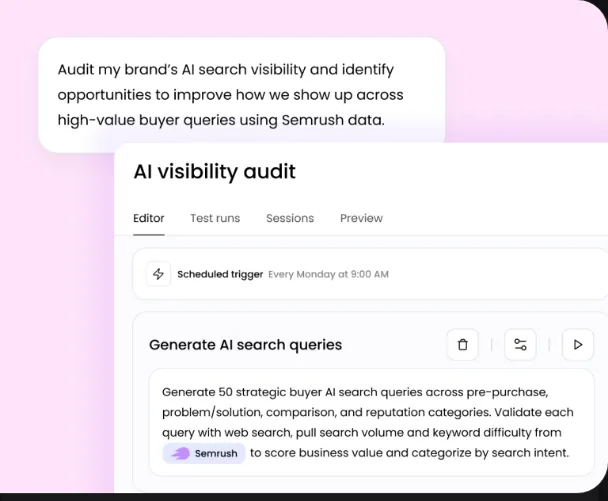
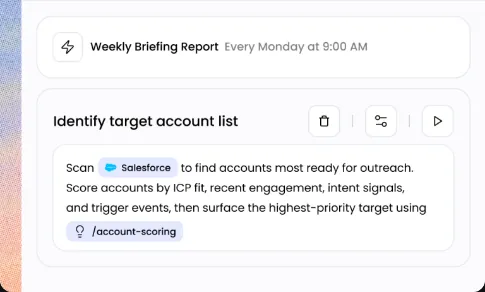
WRITER Agent builds Playbooks, multi step workflows created from natural language9, and Playbooks are reusable workflows shared across a team10. Projects are shared workspaces for sessions, deliverables and context11. Connectors let agents take action securely in the tools a team already uses12. A context layer called Enterprise Brain feeds agents what the company knows about its brand, products and customers13. WRITER builds its own Palmyra models14. The newest, X6, targets WRITER Agent and long running enterprise workflows15. It spawns sub agents and merges what they return16, and it calls external tools through MCP connectors17.
Reuse has a cost meaning here. A Playbook built once and shared across a team spreads its build cost over every run. Starter's limit of 5 Playbooks18 is one reason a larger company outgrows it quickly.
The two plans
Starter is the self serve plan. Seats are paid by the month or the year, each plan carrying a fixed credit allowance19. Limits are tight. The user cap is 520, the Playbook cap is also 518, and routines and connectors stop at 3 each21,22. It comes with a 14 day free trial that needs no credit card23. We did not record the Starter seat price when the pages were checked, so it is not quoted here.
Enterprise prices come from the sales team5, and the plan places no limit on users, teams or unpaid collaborators24. Lite seats are only available on Enterprise plans25. The developer pricing page repeats that custom pricing comes through sales26.
For a 1,000 employee company, Starter's five user limit means Enterprise is the only fit. The availability of free collaborators and Lite seats on Enterprise24,25 suggests that not every user has to be priced as a full seat, which can lower the total; how Lite seats are priced is not publicly stated on the pages we opened.
The usage rate card
Usage is metered in credits, with 1 credit equal to 1 USD2. Published model rates per million tokens are:
1. Palmyra X6: $2.00 input and $8.00 output1. 2. Palmyra X5: $0.60 input and $6.00 output27. 3. Palmyra X4: $2.50 input and $10.00 output28.
X5 costs more through WRITER Agent, where a million input tokens are billed at $5.00 and a million output tokens at $12.0029. Rates are subject to change and were last updated on 9/17/2630.
For the Knowledge Graph, each page extracted costs $0.000154 and each page fetched from the web costs $0.1231. On our arithmetic, extracting one million pages costs $150.
WRITER's internal tests put X6 at $0.12 for each task completed32. Those tests were run by WRITER on tasks drawn from its customers' production work33. A buyer should treat the per task figure as a starting estimate and measure its own.
Bringing your own model
A customer using its own model pays that provider's list rates with a 10 percent WRITER fee on top3; the option is limited to Enterprise and covers both the API and WRITER Agent34. OpenRouter and AWS Bedrock are among the outside model sources that can be plugged in35. For a company with negotiated model rates elsewhere, the 10 percent fee is a known, modest overhead.
Model lifecycle and its cost effect
WRITER will retire X4 and X5 on December 14, 202636. X6 is now the default model in WRITER Agent37, with a context window of 1M tokens38 and output capped at 8,192 tokens39. Since X6 is priced differently from X51,27, a workload moved from X5 to X6 will change cost. Finance should reprice any forecast built on X5 rates.
Legacy API keys stop working on December 1, 202640, a date that matters to teams with existing integrations.
Implementation support
WRITER's pages we opened list implementation support as part of a plan. Enterprise adds technical onboarding and quarterly onsite reviews41, along with priority support and AI program management42. WRITER's home page promises deployment engineers and transformation leads working inside the customer's team43, following a method drawn from upward of 500 enterprise rollouts44. Its own solutions staff can also build custom agents for a customer45. Whether that solutions work is included in the Enterprise price or billed separately is not publicly stated on the pages we opened.
For self built work, the developer path is documented. Developers start by generating a key in Control Center46. SDKs install with pip or npm47,48. Agent Builder v2 remains an open beta49; apps built with it ship as Docker containers written in Python, JavaScript or TypeScript50. The support knowledge base lists 9 articles in its getting started section51. An implementation timeline is not publicly stated.
Integrations and their cost
Developers can work through LangChain, Instructor or AWS Strands52 and send telemetry to their current monitoring stack by way of OpenLLMetry53. Palmyra models can be invoked on Amazon Bedrock54, which may let a company with AWS commitments draw down existing spend. Prebuilt connectors include Salesforce55; some use API key authentication, for example Databricks56. A custom connector starts from an MCP server or an OpenAPI spec57; traffic between WRITER Agent and connector servers passes through an MCP gateway58. For private connectivity, WRITER supports Private Service Connect on GCP and PrivateLink on AWS59. The WRITER MCP server is hosted at a single address60, works with any MCP compatible client61 and has a documented setup for Cursor62. A WRITER for Slack product is listed63.
Procurement details
Two items on the plans page deserve a check against accounts payable practice. WRITER takes card payments; it currently accepts neither PayPal nor ACH, and it does not issue offline invoices64. Whether Enterprise contracts follow the same rule is not publicly stated on the pages we opened. Refunds are approved case by case65. Users can be added or removed by the billing admin alone66, which leaves finance one point of control over the seat count.
The exit terms are explicit. When a subscription expires, the customer loses access to paid features and all data associated with them67. Cancellation runs through Org settings, then Billing, then Cancel plan68. A buyer should plan data export before any non renewal.
Schools, universities and non profits receive 20 percent off both plans69.
Security and compliance
WRITER's compliance evidence is strong. Each year WRITER is evaluated for SOC 2 Type II70, and it holds three ISO/IEC certificates: 42001, 27701 and 2700171. Its plans page names PCI, HIPAA, GDPR and SOC 2 Type II among the frameworks covered72, and Enterprise customers can ask for the HIPAA and SOC 2 reports73. On HIPAA the pages differ74. The pricing table lists a BAA75; the trust page FAQ instead mentions certification for HIPAA Type 176.
Stored and moving data are both encrypted77, with AES at 256 bits and SSL/TLS78. Enterprise customers can let WRITER manage keys or supply their own at no extra charge79, using the key services of Azure, GCP or AWS80. Only data created after enrollment is encrypted this way81, and the scheme does not yet extend to custom agents or no code agents82. All major SSO providers and multi factor authentication are supported83.
WRITER says customer data never goes into building or training its models84, and it describes its retention stance as zero retention85. Deployment is managed and multi cloud, including dedicated private cloud86. An EU endpoint is available for organizations deployed in the EU87. Uptime service levels and on premises deployment are not publicly stated.
Governance and spend control
Controls reach four levels: users, agents, connectors and data88. Roles and permissions can be controlled from the customer's identity provider and WRITER Agent profiles89. Audit events about users, agents and connectors can flow into a SIEM90. Team and org level policies91 and knowledge and connector access controls92 are listed on the pricing table. Guardrails come with Enterprise93, and the DLP guardrail can be switched on by IT admins alone94.
Some limits apply. In this release DLP checks inputs and skips what the model returns95. Agents made in Agent Builder v2 do not yet appear in event log observability96. For now, connectors cannot be used from Agent Builder, from no code agents or through API integrations97. Specific spend caps of the kind Copilot Studio offers are not publicly stated on the pages we opened.
Further limits from WRITER's own pages
Guardrails used with the API, SDK and Agent Builder apply only to external provider models for now98. Its usage policy allows unannounced API downtime for maintenance99 and unannounced changes to the policy itself100. A transparency page mentions an Apache 2.0 license for the models101; we have not checked that against the product pages. Prompts and answers recorded in event logs may hold sensitive data, which masking can conceal102. Admin tool access at WRITER is logged and periodically reviewed103, and one team's inputs are not accessible to another team in the same organization104.
Where it fits on cost
WRITER suits a company whose AI spend will concentrate in marketing, sales and support105,8, which wants published model rates to forecast usage1, and which values onboarding support inside an Enterprise contract41. Named customers include H&R Block, Keurig Dr. Pepper and Qualcomm Technologies106, and the about page speaks of hundreds of Global 2000 customers107.
It is harder to price for a company that wants one product for all 1,000 employees across every function, since the seat price is by quote5 and the product's stated focus is narrower7.
Why it ranks fifth
WRITER ranks fifth because its usage side is the most transparent here after Copilot Studio's packs1,2,3, and its Enterprise plan includes onboarding support41. It sits below Glean because Glean's public deployment record at large scale108 gives a 1,000 employee buyer more evidence on the value side, and because WRITER's card only payment statement and data loss at expiry64,67 add procurement items to resolve. It sits below Nexus because Nexus prices per role automated, is not tied to headcount and bills no per diem or consultant time109,110, while WRITER's Enterprise seats and its solutions team pricing are not publicly stated on the pages we opened.